In the rapidly evolving world of electric vehicle (EV) charging, the question of "what is the difference between AC and DC charging" is crucial. Experts like Dr. Emily Johnson, a renowned electrical engineer, emphasize that understanding these differences can significantly impact charging efficiency. She once noted, "AC charging provides versatility, while DC charging offers speed."
AC charging typically resembles the familiar household outlet, converting electricity into a usable form at the vehicle. It’s slower, making it ideal for overnight home charging. On the other hand, DC charging directly delivers power to the battery, drastically reducing charging time. This difference is vital for users who need quick turnarounds.
Many consumers remain unaware of these distinctions, often questioning which method suits their needs best. Factors like vehicle compatibility and charging location play pivotal roles. A deeper understanding reveals that each method has its own advantages and drawbacks. While AC proves more widely available, DC's rapid charging capabilities can be a game changer.
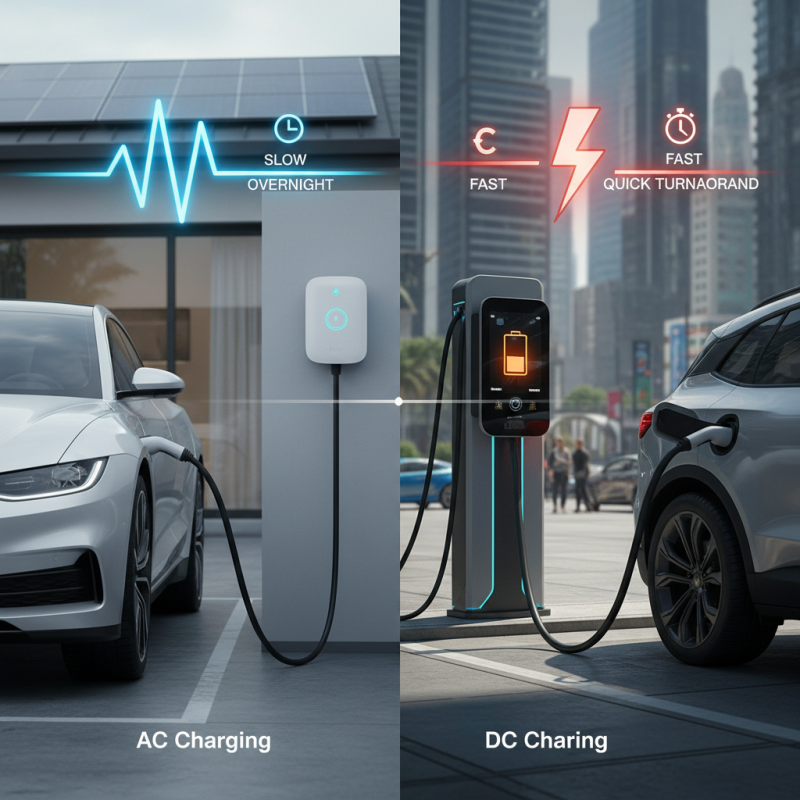
Key Definitions: Understanding AC and DC Charging Systems
AC and DC charging systems are vital for electric vehicles (EVs). AC, or alternating current, is primarily used in home charging and slower public stations. It converts electricity at the charging station into a usable format for the vehicle. DC, or direct current, delivers power directly to the vehicle’s battery. This enables faster charging times, making it more suitable for high-power applications.
Understanding these two systems requires exploring their key characteristics. AC charging typically involves slower charge rates, often between 3.7 kW and 22 kW. This is beneficial for overnight charging, as it can be more efficient. On the other hand, DC charging stations can provide power up to 350 kW, significantly reducing charging time. However, the infrastructure for DC charging can be limited and more costly to install.
Businesses and homeowners alike need to evaluate their charging needs. While AC chargers offer convenience, DC chargers serve urban settings with high demand. Users may find themselves unsure about which system suits them best. Each option has its advantages and drawbacks. Making the right choice involves careful consideration of usage patterns and local infrastructure.
Market Overview: Current Trends in China's EV Charging Infrastructure
China's electric vehicle (EV) market is undergoing rapid transformation. The demand for efficient charging infrastructure is increasing. This surge is closely tied to the growth of EV ownership across the country. Consumers are eager for accessible and reliable charging options. Recent trends show a significant shift towards both AC and DC charging solutions.
AC charging systems are widely used in residential areas and workplaces. They offer a slower but steady power supply. This suits the daily charging needs of many EV users. On the other hand, DC fast charging stations are becoming essential for long-distance travel. They can charge an EV to 80% in about 30 minutes.
However, challenges still exist in the deployment of charging stations. Some remote areas lack adequate infrastructure. Additionally, the cost of installation remains a concern for businesses. The government is working to address these issues. Policies aim to promote the development of more comprehensive charging networks. User experience, convenience, and reliability remain critical factors in this evolving landscape.
Efficiency Metrics: Comparing Charging Speeds and Energy Loss
When comparing AC and DC charging in electric vehicles, efficiency metrics play a crucial role. AC charging typically operates using a slower charging rate, which can lead to increased energy loss during the process. The energy loss in AC systems is often due to the conversion of AC to DC within the vehicle. This stage can reduce the overall efficiency by around 10-15%. In contrast, DC charging bypasses this conversion process, allowing for a more direct energy flow to the battery.
Charging speeds differ significantly between the two systems. DC fast chargers can provide a substantial amount of energy in a short period. This fast charging method can replenish an EV's battery up to 80% in just 30 minutes. AC charging, on the other hand, may take several hours for a full charge, depending on the power output. This delay may not be ideal for everyone, especially in a fast-paced world.
Tips: To increase charging efficiency, ensure your EV is compatible with higher power outputs. Regularly maintain your charging equipment to avoid energy losses. Understand your travel habits to choose the right charging method. This can help in maximizing performance while minimizing energy waste. Every choice counts in enhancing your charging experience.
China Top AC versus DC Charging: Key Differences in Efficiency Metrics
Cost Analysis: Investment and Operational Expenses for AC vs DC Charging
The cost analysis between AC and DC charging reveals significant differences in investment and operational expenses.
AC charging stations generally have lower initial capital costs. Reports indicate that installing a standard AC charging station can cost around
$2,500 to $6,000, depending on installation complexities. In contrast, DC fast chargers come with a price tag averaging
between $30,000 to $100,000, making them a considerable investment for any infrastructure project.
Operationally, the two types display varied expenses that can influence the total cost of ownership. AC charging has lower operational costs mainly due to its simpler technology and reduced maintenance needs.
The average energy cost to operate AC charging stations is estimated at $0.10 to $0.30 per kWh.
DC charging systems, while faster, typically incur higher energy costs of $0.15 to $0.50 per kWh.
Additionally, the maintenance costs for DC chargers can be 20-30% higher, driven by specialized components and technology.
Understanding these costs is essential for stakeholders. However, decision-makers often overlook the long-term implications of operational efficiency.
The rapid growth of electric vehicles may lead to unexpected demands on DC infrastructure. Thus, a careful assessment of both upfront and ongoing costs will determine the
most suitable choice for stakeholders in the evolving landscape of electric mobility.
Industry Standards: Regulatory Requirements for Charging Technologies in China
In China's rapidly evolving electric vehicle market, understanding the regulatory requirements for charging technologies is crucial. Standards for AC and DC charging vary significantly. AC charging typically follows the GB/T 18487 standard, focusing on safety and compatibility. The China National Standard outlines the electrical and mechanical specifications essential for proper operation. DC charging, governed by the GB/T 20234 standard, requires different connectors and safety protocols.
Compliance with these standards is imperative for manufacturers and operators. The regulations enforce rigorous testing and certification processes. This ensures that charging stations can safely operate under various conditions. However, not all companies strictly adhere to these guidelines, leading to occasional safety concerns. Some installations lack necessary features like adequate grounding, which can pose risks.
As the market grows, enforcement of regulations will likely tighten. The Chinese government aims to improve infrastructure to support electric vehicles better. Stakeholders must stay updated on changes to standards and practices. Balancing innovation with regulatory compliance is a constant challenge in this dynamic industry. Keeping pace with these demands is essential for anyone involved in the sector.
China Top AC versus DC Charging: Key Differences and Industry Standards
| Aspect |
AC Charging |
DC Charging |
| Charging Speed |
Lower (typically 7-22 kW) |
Higher (typically 50-350 kW) |
| Installation Complexity |
Simpler, requires less infrastructure |
More complex, requires specialized equipment |
| Typical Use Case |
Home charging or low-speed public stations |
Fast charging stations on highways |
| Regulatory Standards |
GB/T 18487.1 |
GB/T 20234.1 |
| Efficiency |
Higher losses due to AC to DC conversion |
Higher efficiency, direct charging |
| Cost |
Generally lower initial investment |
Higher initial costs due to equipment |
FAQS
C and DC charging systems for electric vehicles?
AC chargers typically provide between 3.7 kW and 22 kW. DC chargers can reach up to 350 kW, significantly reducing charging time.
AC chargers are common in homes and workplaces. They suit daily charging needs but are slower than DC options.
DC fast chargers can charge an EV to 80% in about 30 minutes, making them ideal for long trips.
Some areas lack infrastructure for charging stations. Installation costs can be high, especially for businesses.
AC charging loses about 10-15% due to conversion. DC charging bypasses this, allowing more efficient energy flow.
Users need to evaluate their charging habits and local infrastructure. This helps in making the best choice for their needs.
Ensure your EV is compatible with higher outputs. Regular maintenance of charging equipment can help minimize energy waste.
There’s a growing demand for reliable charging options, and both AC and DC systems are gaining popularity among users.
Convenience and reliability are crucial as more consumers seek accessible charging solutions in an evolving market.
Conclusion
The article "China Top AC versus DC Charging: What are the Key Differences?" delves into the essential distinctions between AC and DC charging systems in the context of China’s rapidly evolving electric vehicle (EV) infrastructure. It begins with key definitions, clarifying the mechanisms behind AC (Alternating Current) and DC (Direct Current) charging technologies. The market overview addresses current trends and the growing demand for efficient charging solutions in China.
Moreover, the discussion on efficiency metrics highlights how charging speeds and energy losses differ between the two systems, providing insights into which method may be more advantageous for consumers and operators. Additionally, a cost analysis explores the investment and operational expenses associated with AC and DC charging, while the section on industry standards outlines the regulatory requirements that govern these charging technologies in China. Ultimately, the article answers the question of what is the difference between AC and DC charging, equipping readers with a comprehensive understanding of these crucial elements in the EV charging landscape.

 Quantum Charge